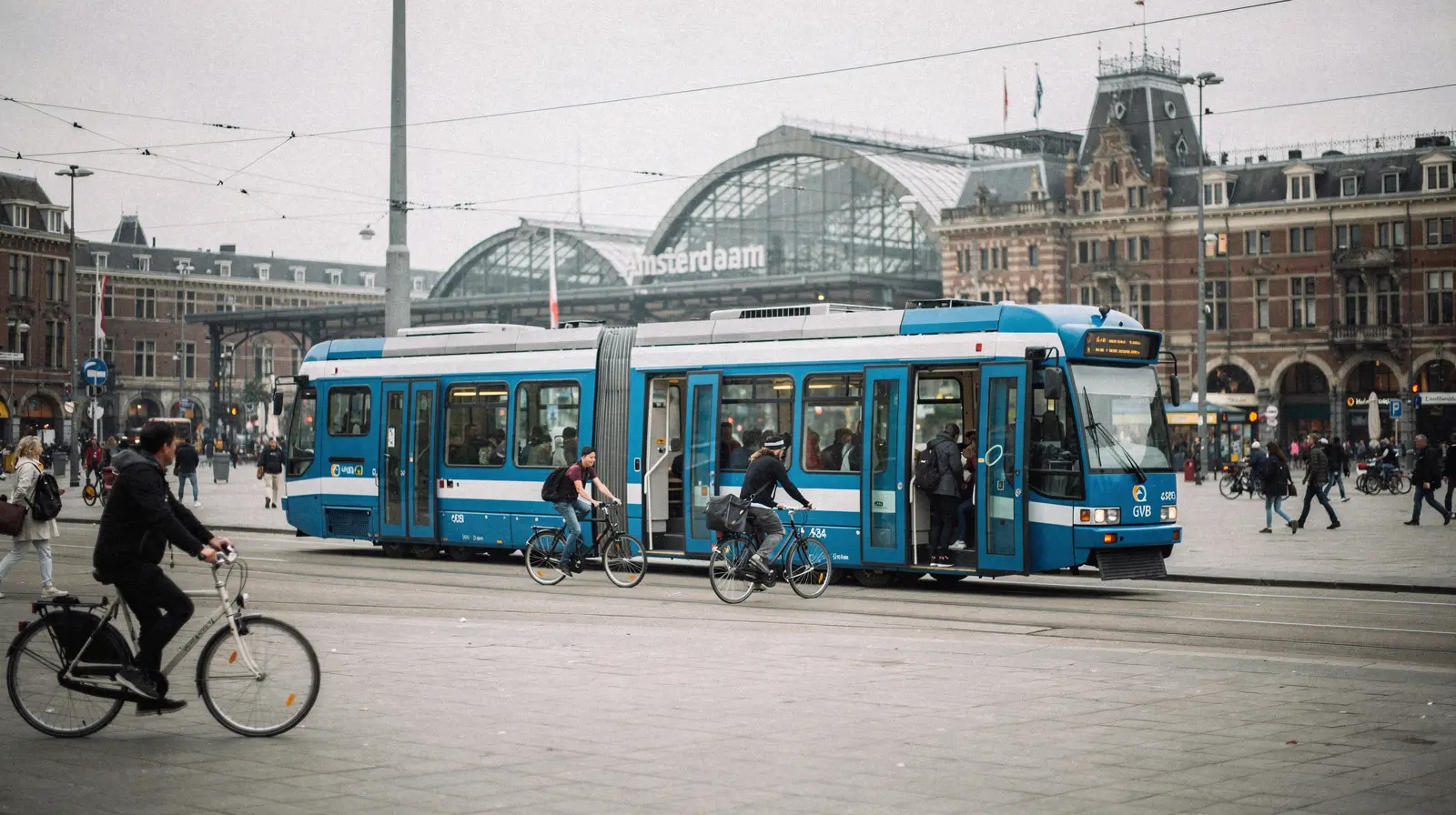
Amsterdam public transport — complete guide to GVB trams, buses and metro
How does public transport work in Amsterdam?
GVB operates trams, buses and metro inside Amsterdam. Pay by contactless bank card (€3.40 per journey) or buy a day pass. Trams cover the tourist core; bikes cover everything else.
GVB: Amsterdam’s public transport operator
The Gemeentelijk Vervoerbedrijf (GVB) runs all trams, buses, metro and the free IJ ferry within Amsterdam’s city limits. Intercity trains are operated separately by NS (Nederlandse Spoorwegen) and use the same physical OV-chipkaart and contactless payment system but have different fare structures.
GVB runs one of the densest urban tram networks in Western Europe. Most of the tourist core — from Centraal to Museumplein, Leidseplein to De Pijp — is covered by at least two overlapping tram lines.
| Operator | GVB (trams, buses, metro, IJ ferries) |
| Cost | Around €3.40 per journey, or €9.00 for a day pass |
| Payment | Contactless bank card, OV-chipkaart, or GVB app |
| Coverage | Dense in the tourist core; bikes fill the gaps |
| Best for visitors | A GVB day pass if making 3+ trips in a day |
Fares in 2026
| Ticket type | Price | Coverage |
|---|---|---|
| Single journey (contactless bank card) | €3.40 | All GVB tram, bus, metro |
| 1-hour transfer (within 60 min) | Free if using same card/device | Tap in on each vehicle |
| GVB day pass | €9.00 | Unlimited GVB 24h from first tap |
| GVB 2-day pass | €15.50 | |
| GVB 3-day pass | €21.50 | |
| Amsterdam Travel Ticket 1-day | €17.00 | GVB + Schiphol NS train |
| Amsterdam Travel Ticket 2-day | €22.50 | |
| Amsterdam Travel Ticket 3-day | €28.00 |
For more detail on the OV-chipkaart versus contactless, see our OV-chipkaart guide.
OV-chipkaart versus contactless bank card
| OV-chipkaart | Contactless bank/phone | |
|---|---|---|
| Setup | Buy and load credit at machines | None — tap your existing card |
| Best for | Longer stays, locals | Short trips, most visitors |
| Refunds | Possible on remaining balance | Automatic, no leftover credit |
| Convenience | Extra card to carry | Uses what’s already in your wallet |
For nearly all visitors, contactless bank card or phone payment is simpler than buying an OV-chipkaart — you avoid the top-up process and there’s no unused balance to refund before you leave.
Tram network
The main lines
Amsterdam has 15 tram lines. The ones most useful for visitors:
Line 2 — Centraal → Nieuw Sloten via Leidseplein and Vondelpark. Core line for museum quarter and parks.
Line 4 — Centraal → Station Zuid via Rembrandtplein and De Pijp. Good for nightlife areas and the south.
Line 5 — Centraal → Leidseplein → Amstelveen. Covers the western museum quarter.
Line 7 — Centraal → Surinameplein via Vondelpark. Good for the western Jordaan area.
Line 12 — Centraal → Jordaan → Vondelparkbuurt. Key line for canal ring and Jordaan neighbourhood.
Line 14 — Centraal → Flevopark via Alexanderplein. Passes the Jewish Quarter and eastern sights.
Line 17 — Centraal → Westwijk via Leidseplein. Good backup for western routes.
Line 24 — Centraal → Amstel (via Oosterdok and De Pijp). Covers ARTIS zoo, Oosterpark, eastern neighbourhoods.
How to board
Trams can be boarded from any door. During peak hours most operators open all doors simultaneously. In quiet periods or on less busy lines, you may need to board from the front door and tap your card on the reader next to the driver.
Press the button marked “Halte aanvragen” (stop request) or any door-open button when approaching your stop. Doors do not open automatically.
Tram stops
Stops are announced by audio and displayed on screens inside newer trams. Older rolling stock may not have visual displays — knowing the order of stops in advance helps.
Which tram for which neighbourhood
If you are staying in or visiting the Jordaan, the Museum Quarter or De Pijp, it helps to pick your base by tram line rather than by distance on the map. Many visitors find that one well-chosen line covers most of what they came for. Our first-time guide to Amsterdam suggests how to group sights so you ride the same line more than once.
Bus network
GVB buses serve areas not covered by trams, particularly in outer neighbourhoods. For most tourist itineraries, trams are more convenient.
Useful bus lines for tourists:
- Bus 22 — Central Station → Haarlemmerplein → Westpoort. Good for western harbour area.
- Bus 48 — Central Station → Bijlmer via Rijnstraat. Outer east.
- Bus 397 — Runs from Schiphol to Leidseplein and Museumplein (operated in conjunction with Connexxion). Useful airport-to-centre alternative to the train if you are staying near the museum quarter.
Night buses (prefix N): Run from approximately 00:30 to 05:30 when regular trams are not operating. Lines N83, N84, N85, N86, N87, N91, N92, N93, N94, N97 cover the main city areas. Fares are slightly higher at night: €5.00 for a single journey.
Night buses are a handy safety net after dinner or drinks, and our nightlife guide shows which areas stay busy late. If your evening is built around the water, an evening canal cruise with city lights and wine usually ends close enough to the centre to pick up a night bus or walk back. For where trains and trams fit into longer excursions, see day trips by train from Amsterdam.
Metro network
Four metro lines run in Amsterdam:
| Line | Route | Key tourist stops |
|---|---|---|
| 50 | Gein ↔ Isolatorweg | Not useful for tourist core |
| 51 | Centraal ↔ Isolatorweg | Centraal, Weesperplein |
| 52 | Noord ↔ De Pijp | Noord, Centraal, Vijzelgracht, De Pijp |
| 53 | Centraal ↔ Gaasperplas | Centraal, Weesperplein, Diemen |
| 54 | Centraal ↔ Gein | Centraal, outer east |
Line 52 (the Noord-Zuid Lijn) is the most useful for tourists: it connects Amsterdam Noord (A’DAM Lookout, NDSM) through Centraal and down to De Pijp in about 10 minutes.
Metro stations have full barriers — you must tap in and out at the gates. Contactless payment and OV-chipkaart both work.
IJ ferries (free)
Four free ferries operate from the docks behind Amsterdam Centraal across the IJ river to Amsterdam Noord. They run every 7–15 minutes and are free for both pedestrians and cyclists.
Buiksloterweg ferry: Most frequent (every 7–8 minutes), drops you near the A’DAM Lookout tower and EYE Film Institute.
IJplein ferry: Every 12–15 minutes, slightly further east in Noord.
NDSM ferry: Every 30 minutes during the day, connects Centraal to the NDSM creative district (street art, STRAAT Museum, food events).
Tolhuistuin ferry: Seasonal, connects to a garden and music venue.
Bikes are always welcome on all ferries at no charge. The crossing takes about 5 minutes.
The ferries are one of the simplest ways to see the city from the water without booking anything. To explore the area on the other side, read our Amsterdam Noord guide and the STRAAT street art museum guide, which both start with the NDSM crossing.
Getting to the airport
The direct train from Amsterdam Centraal to Schiphol Airport takes 15–17 minutes and departs roughly every 10 minutes during the day. Fare is approximately €4.40. For full details see our Schiphol to Amsterdam centre guide.
Accessibility
GVB has been upgrading its fleet to low-floor trams that allow step-free boarding for wheelchairs and pushchairs. As of 2026 most main-line trams use newer rolling stock, but some heritage lines and older routes still have stepped entry. Check gvb.nl for accessibility information by line.
Metro stations on the North-South line (52) are fully accessible with lifts. Older stations vary.
Day passes vs individual tickets: which to choose
Use this rule of thumb:
- 1–2 journeys in a day: Pay contactless per trip (€3.40 each).
- 3+ journeys in a day: Buy a GVB day pass (€9.00 unlimited).
- Multiple days + Schiphol arrival/departure: Consider the Amsterdam Travel Ticket (€17–28 for 1–3 days including Schiphol train).
- Primarily cycling: You may not need any transit pass at all.
If you are also weighing museum entry passes against transit, compare options in our I amsterdam City Card guide, or bundle transit and Schiphol together with the Amsterdam Travel Ticket .
For a complete comparison of transport options including cycling, see getting around Amsterdam.
Public transport versus cycling
Many visitors default to trams without considering that a rental bike often beats public transport for both speed and cost inside the Canal Ring. Trams are faster for longer cross-city hops (Centraal to Noord, or to the outer neighbourhoods); bikes win for the dense historic core where tram routes zigzag around one-way canals.
- Choose trams/metro for: airport transfers, longer distances, rainy days, or if cycling in traffic makes you nervous.
- Choose a bike for: short hops across the centre, flexibility to stop anywhere, and the lower daily cost of a rental versus multiple tram fares.
See the bike rental guide for where to rent, and the cycling in Amsterdam guide for the rules of the road before you join the bike lanes.
GVB app and live information
The GVB app (available for iOS and Android free) shows real-time tram positions, departure countdowns and route planning. Google Maps and Citymapper also work well in Amsterdam and show GVB tram/metro/bus routes in real time.
For tram disruptions — common during evening peak hours — check the GVB service alerts on the app or website before a journey. Trams are often delayed by cyclists or pedestrians blocking lines.
Where to buy tickets and passes
- GVB vending machines at Centraal, major tram stops and metro stations
- Aboard trams from the driver (cash only, more expensive)
- NS ticket machines (for Amsterdam Travel Ticket with Schiphol train)
- GVB service desk at Amsterdam Centraal (Stationsplein side)
- GVB app (day passes and multi-day passes can be loaded to your phone)
Frequently asked questions about Amsterdam public transport
How often do Amsterdam trams run?
During daytime (07:00–19:00), main tram lines run every 5–8 minutes. Evening services are every 10–15 minutes. Night buses run every 30–60 minutes from approximately 00:30. During special events like King’s Day or major football matches, extra services are added.
Can I use one GVB day pass for multiple people?
No. Each person requires their own pass or must pay a separate fare. GVB passes are registered to the tap of a single card or device.
What is the difference between GVB and NS tickets?
GVB operates trams, buses and metro within Amsterdam’s city limits. NS operates intercity and regional trains, including the Schiphol connection. GVB day passes do not cover NS trains. The Amsterdam Travel Ticket covers both.
Are there tourist transit passes specifically for Amsterdam?
The GVB day/2-day/3-day pass is the basic transit option. The Amsterdam Travel Ticket adds the Schiphol train. Neither includes museum admission — that is handled by the I amsterdam City Card separately.
What happens if I board without a valid ticket?
GVB inspectors (in plain clothes or uniform) conduct random checks. Travelling without a valid ticket or without tapping in results on-the-spot fine of €50 plus the journey fare. There is no discretion — inspectors issue fines for forgotten tap-ins even if you meant to pay.
Is it better to walk, cycle, or take the tram in central Amsterdam?
For the Canal Ring, Jordaan, and Museum Quarter, walking or cycling is usually faster than waiting for a tram, since routes bend around canals. Trams pay off for longer hops — Centraal to Noord, or out to De Pijp and beyond. Most visitors end up combining all three depending on distance and weather.
Does my GVB pass work on the airport train to Schiphol?
No. GVB passes cover trams, buses, metro and the IJ ferries only. The Schiphol connection is an NS train, covered separately or via the Amsterdam Travel Ticket, which bundles GVB with Schiphol train travel. See the Schiphol to Amsterdam centre guide for the full journey breakdown.
Related guides

Amsterdam Schiphol airport guide — everything you need to know
Schiphol airport layout, terminals, lounges, luggage storage, transport to the city and insider tips for a smooth transit.

Getting around Amsterdam — tram, bike, boat and on foot
Complete guide to transport inside Amsterdam: tram, metro, bike rental, walking, ferries and taxis. Real 2026 prices.

OV-chipkaart guide for Amsterdam visitors
Everything about the Dutch OV-chipkaart transit card — cost, how to load it, and whether you need one in 2026.

Getting from Schiphol airport to Amsterdam city centre
Train, bus, taxi or shuttle from Schiphol to central Amsterdam — times, prices and honest advice for 2026.