Amsterdam first time guide — essential tips for your first visit
What should first-time visitors prioritise in Amsterdam?
The Rijksmuseum and a canal cruise are non-negotiable. Add the Jordaan walk and Van Gogh Museum. Book Anne Frank House well in advance — it sells out. Skip the tourist trap restaurants on the Damrak.
| Where to stay | Canal ring, Jordaan or De Pijp for walkability |
| Cost | Around €120–200/night mid-range hotel; €40–60/day for food and transport |
| Time needed | 3 days minimum; 4–5 for a relaxed first visit |
| Getting there | Train from Schiphol, 15–17 min to Centraal, around €4.40 |
| Best time | May or September for mild weather with fewer peak-season crowds |
Before you arrive: the three most important bookings
Most Amsterdam visits go wrong not because of bad planning but because of three forgotten bookings:
-
Anne Frank House — book 6–8 weeks in advance in summer, 2–4 weeks in autumn and spring. Same-day tickets are almost impossible to get. The museum does not sell them at the door. iamsterdam.com/en/anne-frank-house.
-
Van Gogh Museum — also sells out weeks ahead in summer. Book at vangoghmmuseum.nl. First-morning slots (09:00–10:30) are the least crowded.
-
Rijksmuseum — more flexible than the other two but pre-booking a timed-entry slot is still recommended in July–August. You can often get same-day or next-day slots.
Make these three bookings before you arrange anything else.
Once the dates are fixed, build the rest of the trip around them. Anne Frank House and the Van Gogh Museum are both timed-entry, so the sensible order is to lock those two first, then slot the Rijksmuseum into whichever day has room. Our dedicated pages cover each in more depth: the Anne Frank House guide, the Van Gogh Museum guide and the Rijksmuseum visitor guide. If you are comparing ways to save time at the door, skip-the-line museum options explain what is worth paying for. And if you are unsure when to travel at all, start with the best time to visit Amsterdam.
How Amsterdam is laid out
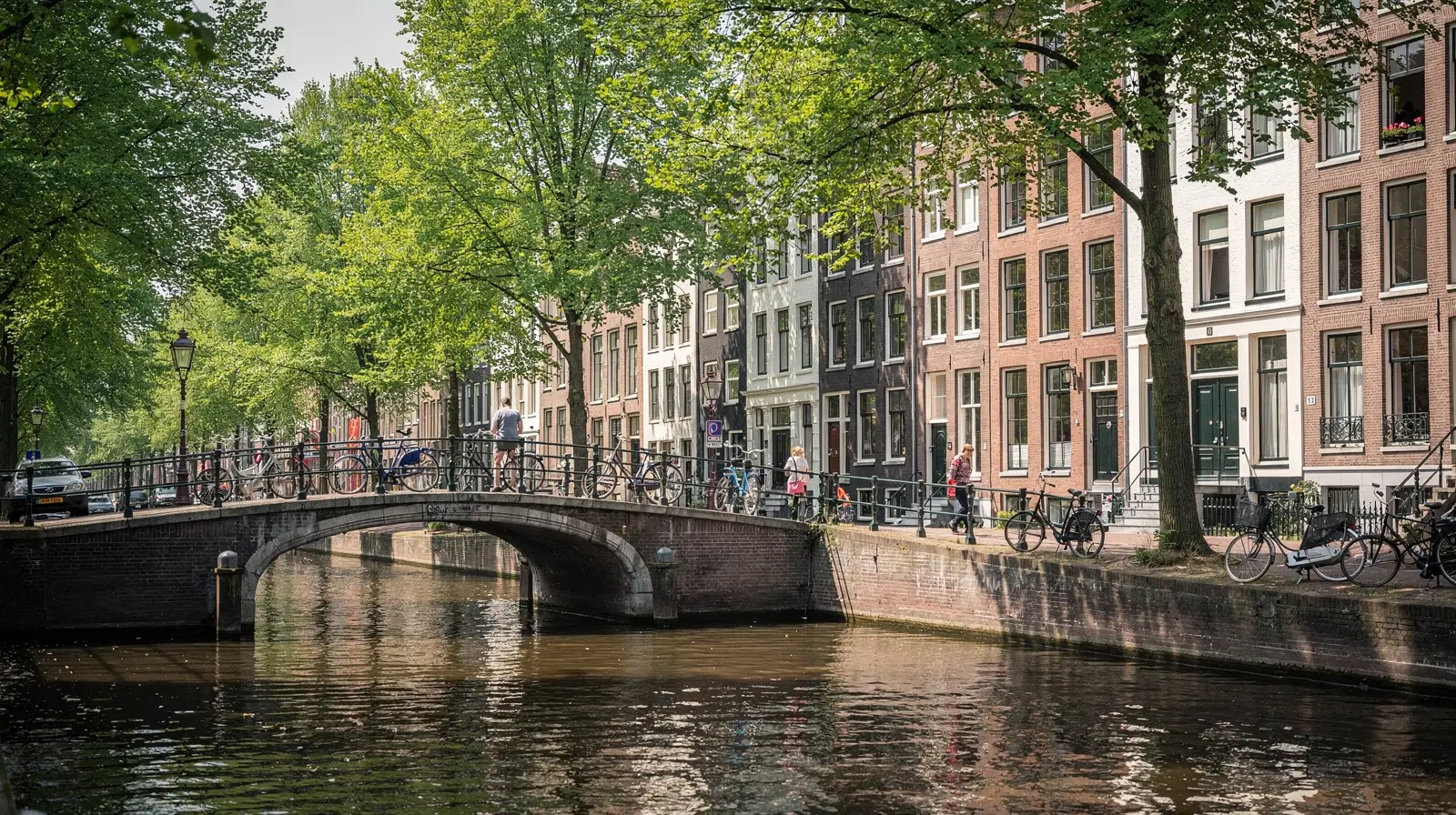
Amsterdam’s historic centre is built on a series of concentric canals — the Grachtengordel, or canal ring. Imagine a horseshoe of canals curving from Amsterdam Centraal station in the north, with the main canals (Herengracht, Keizersgracht, Prinsengracht) forming three rings.
Key areas for first-timers:
- Centraal and the Damrak — the main tourist entry point. Busy, noisy, some scam-adjacent shops and poor-value restaurants. Pass through but don’t linger.
- Dam Square — the historic heart of the city. Royal Palace, National Monument. Worth 30 minutes.
- Canal ring (Grachtengordel) — the UNESCO-listed core of Amsterdam. Walk along the Herengracht or Prinsengracht for the classic views.
- Jordaan — the most charming neighbourhood, west of the canal ring. Brown cafés, Anne Frank House, independent shops.
- Nine Streets (De 9 Straatjes) — a grid of boutique streets between Jordaan and Centraal. Excellent for shopping and café breaks.
- Museum quarter (Museumplein) — Rijksmuseum, Van Gogh Museum, Stedelijk, Vondelpark.
- De Pijp — south of the museum quarter. Albert Cuyp Market, best restaurant strip in the city.
The distance from Centraal to Museumplein is about 2.5 km — a 30-minute walk through the canal ring, or 10 minutes by tram.
The things that are genuinely worth it
Rijksmuseum
The Netherlands’ national art museum holds Rembrandt’s “Night Watch” and Vermeer’s “The Milkmaid” among 8,000 items on display. Allow 2–3 hours. The building itself is as impressive as the art — architect Pierre Cuypers built it in 1885. Buy timed-entry in advance; the queue without a booking can be long.
Van Gogh Museum
The largest collection of Van Gogh’s work anywhere — 200 paintings and 500 drawings, all shown in chronological context of his life. Smaller and more intimate than the Rijksmuseum. Allow 1.5–2 hours. Book in advance — a consistent sell-out.
Anne Frank House
One of the most emotionally significant sites in Europe. The secret annex where Anne Frank hid for two years is preserved largely as it was. The experience is sobering and powerful. Allow 1.5–2 hours. Book weeks in advance.
Canal cruise
Seeing the canal ring from the water puts everything in context. A 75-minute audio-guide canal cruise covers the main canal belt and gives good views of the townhouses and bridges. Do this on day 1 to orient yourself.
On a first morning, a guided walking tour of the must-see attractions does the orientation job faster than a map: two or three hours on foot fixes the relationship between Centraal, the Dam, the canal ring and the museum quarter, and the rest of the trip is easier for it.
Jordaan neighbourhood walk
Two to three hours of wandering the Jordaan — along Prinsengracht, through Noordermarkt square, past the Westerkerk — costs nothing and shows you what Amsterdam actually looks like when it is not covered in tourists. Go on a Saturday morning when the organic market at Noordermarkt is running.
Let the walk be unplanned. Cross a bridge because it looks pretty, stop at a brown café when the weather turns, and turn down side streets that tourist maps ignore. The Jordaan neighbourhood guide and the Jordaan destination page suggest streets and stops, and brown cafés in Amsterdam explains what to order and how to behave once you sit down. When you want shops after the wander, the Nine Streets shopping guide is the natural next step.
A walk through the canal ring at golden hour
The Herengracht and Prinsengracht between 18:00 and 20:00 in spring/summer are among the most beautiful urban scenes in Europe. Take a walk along the “Golden Bend” (Gouden Bocht, the widest section of Herengracht between Vijzelstraat and Leidsestraat) for the most iconic views.
The light is what makes this walk, so keep the evening free of reservations if you can. Take your time, look up at the gabled facades and the leaning houses, and let the reflections in the water do the work. For more on the area, read the canal ring guide or the canal ring destination page. If you would rather see it from the water after dark, compare the options in our evening canal cruises guide and the canal cruise comparison.
What to skip or approach with caution
Restaurants on the Damrak
The strip from Centraal to Dam Square is lined with tourist restaurants offering mediocre food at inflated prices. Walk two streets either side for the same quality at 30–40% less. See our full Amsterdam tourist traps guide.
Heineken Experience
At €21 per person for a 90-minute self-guided tour with two small beers at the end, the Heineken Experience is widely considered poor value. The content is largely a marketing presentation. For the same money, spend an evening at a genuine Amsterdam craft beer bar. Full honest review in our Is the Heineken Experience worth it guide.
Flower market bulbs (non-EU travellers)
The Bloemenmarkt on the Singel canal is visually beautiful but its tulip bulbs are typically non-plantable (treated for export) and some varieties are illegal to import into non-EU countries including the USA, UK and Australia. Buy them only as decoration, not for planting.
Madame Tussauds
€27 per person for waxworks that are identical to any other Tussauds. Skip it.
Other common first-timer traps
Beyond these, many first-time regrets come from the same pattern: paying a premium for something that sounds essential but is not. Our overrated Amsterdam attractions and common Amsterdam mistakes pages go through them one by one, so you can decide where your time and money matter most.
Getting your bearings
If you want an immediate orientation, a small-group city highlights walking tour on your first morning gives context and covers the canal ring, Dam Square, the Jordaan and the Red Light District in 2.5–3 hours with a knowledgeable local guide.
After that, the best way to explore independently is by bike. Most of the tourist core is a 15–20 minute cycling radius from Centraal. Bike rentals are available throughout the city from €10–15 per day.
If cycling appeals, read the bike rental guide and the cycling etiquette and safety guide before you pick up a bike; the unwritten rules of the bike lanes matter more than the bike itself. The Amsterdam public transport guide covers the alternative.
For transport logistics, see our getting around Amsterdam guide and OV-chipkaart guide.
How many days do you need
Three days is the practical minimum for a satisfying first visit: one day for the museum quarter (Rijksmuseum and Van Gogh), one for the canal ring and Jordaan, and one for Anne Frank House plus a day trip or the Albert Cuyp Market. Four to five days lets you add a day trip to Haarlem or Zaanse Schans without rushing the city itself. See the full how many days in Amsterdam guide for itinerary breakdowns by trip length.
If you prefer a ready-made plan to building your own, the one-day, two-day for first-timers and three-day itineraries lay the days out step by step. For a first look at where the best areas sit, see best neighbourhoods in Amsterdam, and for day trips beyond the city, best day trips from Amsterdam.
Where first-timers should stay
The canal ring (Grachtengordel) puts you within walking distance of almost everything and is the classic choice, though also the most expensive. The Jordaan is quieter and more residential with excellent cafés, a short walk from the centre. De Pijp is good value and puts you near the Albert Cuyp Market and the museum quarter. Avoid booking directly on the Damrak or immediately around Centraal — convenient for the train but the least atmospheric and most tourist-heavy part of the city. The full where to stay in Amsterdam guide breaks down each neighbourhood by budget and trip type.
If you are flying into Schiphol, see the Amsterdam airport guide for terminal layout, luggage storage and the fastest way into the city.
Practical basics
Language: Dutch, but English is spoken by virtually everyone in the tourist zone and by most Amsterdammers under 50.
Currency: Euro. Almost all businesses accept contactless card. Keep €20–30 cash for markets and older cafés.
Tipping: 10–15% at restaurants for good service, rounding up is typical. Not mandatory. See tipping etiquette in Amsterdam.
Safety: Amsterdam is very safe for tourists. The main risks are pickpockets in the tourist core (Centraal, Damrak, trams, Leidseplein at night) and cycling accidents. Keep your phone in your front pocket.
Weather: Bring a light rain jacket regardless of season. Amsterdam gets frequent light rain year-round. In winter add a warm layer; in summer evenings cool down quickly.
Cannabis: Legal to possess up to 5g and to consume in designated coffeeshops. Smoking in the street is not illegal but socially frowned upon in most areas. Not all cafés are coffeeshops — see our full guide on understanding the difference.
Frequently asked questions from first-time visitors
What is the number one mistake first-time visitors make in Amsterdam?
Not booking Anne Frank House in advance. It is the most commonly reported disappointment — visitors discover on arrival that all tickets are sold out for their entire stay. Book weeks ahead at annefrank.org.
Is Amsterdam safe for solo travellers?
Yes, very much so. Amsterdam has low violent crime rates and is welcoming to solo visitors of all types. The main risk is petty theft (pickpockets) in crowded tourist areas. Evening walking in most central neighbourhoods is perfectly safe.
Do I need to tip in Amsterdam?
Tipping is appreciated but not obligatory. For restaurant meals, 10–15% for good service is customary. Rounding up the bill (to the nearest €5 or €10) is common for simpler meals. See our tipping etiquette guide for full details.
Should I rent a bike as a first-time visitor?
Yes, if you are reasonably confident on a bicycle. The city is flat, the cycle paths are wide and well-marked, and cycling feels natural after 20–30 minutes of adjustment. If you are not comfortable in traffic, stick to trams for the first day and try cycling on day 2.
Is Amsterdam suitable for children?
Very much so. NEMO Science Museum, ARTIS Royal Zoo, the canal cruises and Vondelpark are all family-friendly. The Red Light District is a legal adult area but is not off-limits for families during the day — it is a functioning neighbourhood. See our Amsterdam with kids guide for a full family itinerary.
How many days should a first-time visitor spend in Amsterdam?
Three days is a practical minimum to see the major museums, walk the canal ring and Jordaan, and visit Anne Frank House without rushing. Four to five days allows a day trip to Haarlem, Zaanse Schans or the Keukenhof (in spring) without compressing the city itself. See the how many days in Amsterdam guide for detailed day-by-day plans.
Where should first-time visitors stay in Amsterdam?
The canal ring is the classic, most walkable choice; the Jordaan is quieter with excellent cafés; De Pijp offers better value near the Albert Cuyp Market. Avoid staying directly on the Damrak. See the where to stay in Amsterdam guide for a neighbourhood-by-neighbourhood breakdown.
Related guides

Amsterdam travel budget — how much does a trip cost in 2026?
Honest breakdown of Amsterdam costs by day: backpacker €75–100, mid-range €150–220, luxury €250–500+. Accommodation, food, transport and entry fees.

Amsterdam packing guide — what to bring in every season
What to pack for Amsterdam: rain gear essentials, cycling shoes, what to leave behind and seasonal checklists for spring, summer, autumn and winter.

Amsterdam safety guide — is Amsterdam safe and what to watch out for
Amsterdam is a safe city for tourists but pickpocketing and cycling hazards are real. Honest advice on the scams, the safe neighbourhoods and what locals

How many days do you need in Amsterdam?
3 days covers the highlights; 5 days adds depth and day trips. Here's an honest breakdown of what you can realistically see in 1 to 7 days.