Amsterdam travel budget — how much does a trip cost in 2026?
How much does a trip to Amsterdam cost per day?
Budget travellers spend €75–100 per day, mid-range visitors €150–220, and luxury travellers €250–500+. The three biggest costs are accommodation, restaurant meals and museum entry fees.
The honest numbers
Amsterdam is an expensive city by European standards — similar to Copenhagen or Stockholm, more expensive than Barcelona or Lisbon, less expensive than London or Zurich. The good news is that the free or low-cost options are genuinely good: canal-side walking, free markets, free beaches (IJburg), free Noord ferry, Vondelpark. You can have an excellent visit without spending a fortune on attractions.
Here is the full breakdown by budget tier for 2026.
| Backpacker | Around €75–100/day |
| Mid-range | Around €150–220/day |
| Luxury | Around €250–500+/day |
| Biggest costs | Accommodation, restaurant meals, museum entry |
| Free wins | Vondelpark, canal walking, IJ ferry, IJburg beach |
For a real, day-by-day account rather than tier averages, our three-day Amsterdam budget breakdown walks through actual spending from a real trip.
Accommodation
Accommodation is typically the largest expense for visitors.
| Tier | Type | Price per night |
|---|---|---|
| Backpacker | Hostel dorm (6–8 bed) | €30–50 |
| Budget solo | Private hostel room or budget hotel | €80–120 |
| Mid-range | 3-star hotel, good location | €120–180 |
| Mid-range (peak) | 3-star hotel, Jul–Aug or King’s Day | €180–250 |
| Upscale | 4-star boutique hotel | €200–350 |
| Luxury | 5-star canal hotel | €350–700+ |
Seasonal variation is significant. Hotels in July–August cost 40–60% more than in November. The best value window is September–October (mild weather, lower prices, fewer crowds). January–February offers the cheapest rates (€80–150 for mid-range) but cold, dark days and limited outdoor dining.
Location matters: Hotels in the Jordaan or canal ring cost more than equivalent hotels in De Pijp or Amsterdam Oost. Both are excellent neighbourhoods with good transport links. See our where to stay in Amsterdam guide for a neighbourhood-by-neighbourhood breakdown.
Food and drink
Breakfast
Most hostels include breakfast. Mid-range hotels may charge €15–25 extra for it — often not worth it when you could go to a neighbourhood café.
Budget breakfast: bakery coffee and pastry €4–7. Mid-range: sit-down café breakfast €10–15. Hotel breakfast: €15–25.
Lunch
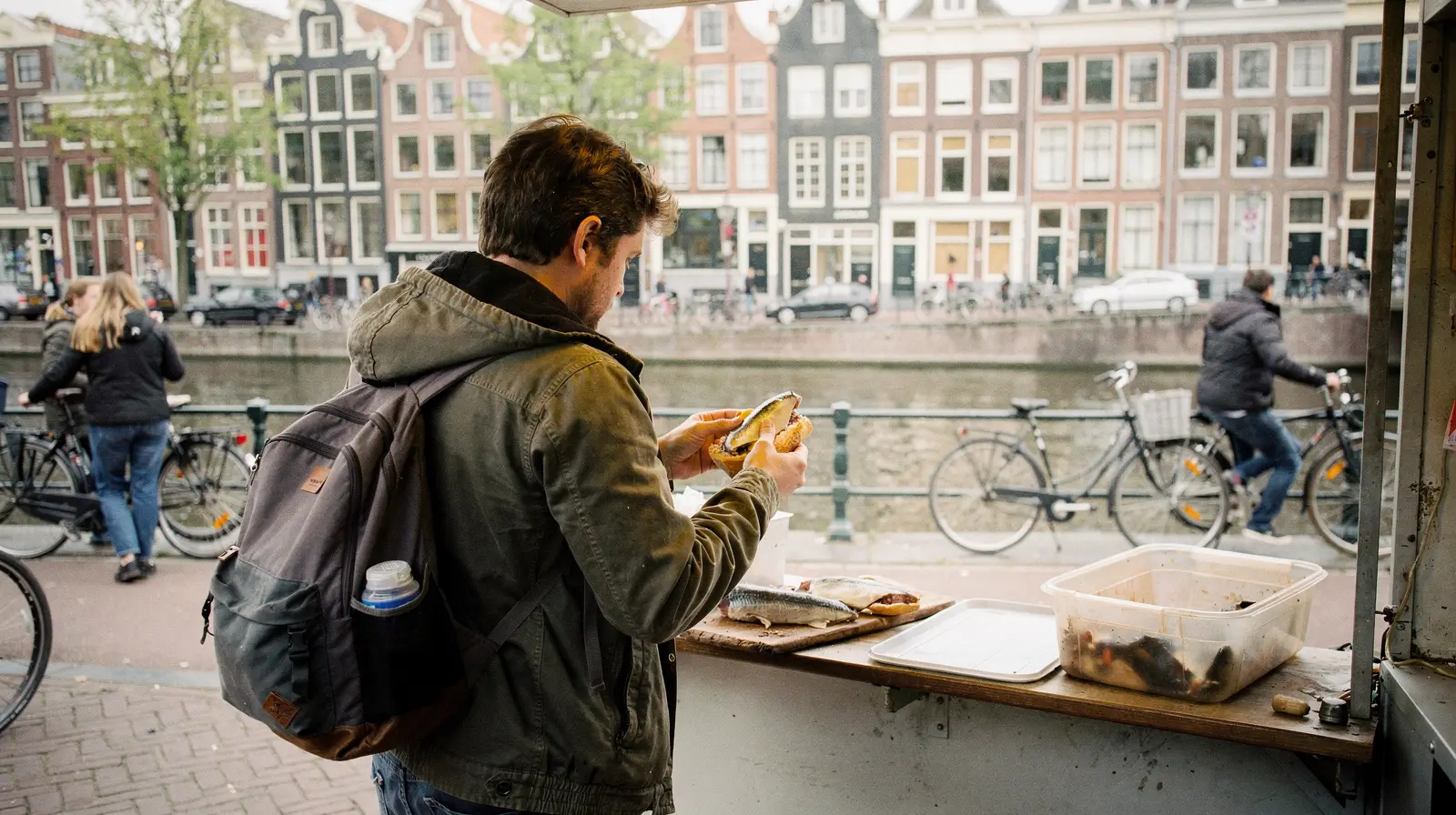
- Budget: Stroopwafel, herring from a street cart, takeaway sandwich — €3–8.
- Casual café: Soup, sandwich and coffee — €12–18.
- Restaurant lunch: Two courses and a drink — €20–30.
Dinner
This is where Amsterdam costs add up. Budget travellers typically have one proper restaurant meal per trip and rely on supermarkets, markets and street food otherwise.
- Supermarket dinner (Albert Heijn, Jumbo): €6–10 for a prepared meal or groceries.
- Street food (Albert Cuyp market, NDSM): €5–12 per dish.
- Budget restaurant (Indonesian rijsttafel, Middle Eastern): €15–25 per person.
- Casual Dutch/international restaurant: €25–40 per person with drinks.
- Mid-range restaurant (canal-side, tourist strip): €40–60 per person.
- Fine dining: €80–150+ per person.
Where not to eat: The restaurants directly on the Damrak (the main tourist boulevard from Centraal to Dam Square) are the worst value in Amsterdam — tourist-trap pricing with mediocre food. Avoid. Walk two blocks in any direction for better, cheaper options. See our Amsterdam tourist traps guide for the full list.
Transport
Amsterdam is compact and walkable. Most visitors spend far less on transport than they expect.
| Transport method | Daily cost estimate |
|---|---|
| Walking only (most sights) | €0 |
| Bike rental | €10–20 |
| GVB trams, 2–3 trips | €6.80–10.20 (contactless) |
| GVB day pass | €9.00 |
| Taxi (1–2 rides) | €15–30 |
| Schiphol train one way | €4.40 |
Most mid-range visitors spend €5–15 per day on transport, primarily GVB trams. Cyclists may spend €15–20 on bike rental but save on trams. For full details see getting around Amsterdam.
Museum and attraction entry fees (2026)
| Attraction | Ticket price |
|---|---|
| Rijksmuseum | €22.50 |
| Van Gogh Museum | €22 |
| Anne Frank House | €16 (online booking required) |
| Stedelijk Museum | €22.50 |
| Moco Museum | €20 |
| NEMO Science Museum | €17.50 |
| ARTIS Royal Zoo | €24 |
| Heineken Experience | €21 |
| A’DAM Lookout | €17.50 |
| Royal Palace | €12.50 |
| Rembrandt House | €17 |
| Amsterdam Dungeon | €22 |
These prices add up fast. A couple visiting Rijksmuseum, Van Gogh and Anne Frank pays €120 in entry fees alone.
Is the I amsterdam City Card worth it?
The I amsterdam City Card costs €60 (24h), €80 (48h), €100 (72h) or €115 (96h) and includes free entry to most major museums plus unlimited GVB transport.
Critical caveat: The card does not include Van Gogh Museum or Anne Frank House since 2022. These two are among the most visited museums in Amsterdam. If those are your priorities, the card’s value calculation changes significantly.
Our dedicated I amsterdam City Card guide runs through the exact maths.
Also compare with Go City Amsterdam pass which has different inclusions — see our full I amsterdam Card vs Go City comparison.
A canal cruise is one of the best-value single attractions regardless of budget tier — a 75-minute audio-guide canal cruise costs about the same as a museum entry but covers dozens of sights at once. See the best canal cruises guide for the full range of options and prices.
Daily budget summary
Backpacker: €75–100 per day
- Hostel dorm: €35–45
- Meals (self-catering + 1 café): €20–25
- 1–2 tram rides: €6–8
- 1 museum or canal cruise: €17–22
- Total: €78–100
Mid-range: €150–220 per day
- 3-star hotel: €130–160 (based on 2 people sharing)
- Meals (café lunches, sit-down dinner): €45–60
- Transport (day pass or bike): €9–15
- 2 museums or 1 museum + canal cruise: €40–50
- Total: €150–220 per person (couple sharing room)
Luxury: €250–500+ per day
- 4–5 star hotel: €200–500
- Fine dining dinner: €80–150
- Private tour or dinner cruise: €80–150
- Transport (private transfer or taxis): €30–50
- Total: €250–500+
The three tiers side by side
| Backpacker | Mid-range | Luxury | |
|---|---|---|---|
| Sleep | Hostel dorm, €35–45 | 3-star hotel, €130–160 | 4–5 star, €200–500 |
| Eat | Self-catering + 1 café, €20–25 | Café lunches + sit-down dinner, €45–60 | Fine dining, €80–150 |
| Move | 1–2 tram rides, €6–8 | Day pass or bike, €9–15 | Private transfer/taxi, €30–50 |
| See | 1 museum or cruise, €17–22 | 2 museums or cruise, €40–50 | Private tour/dinner cruise, €80–150 |
| Daily total | €75–100 | €150–220 | €250–500+ |
Where to save money
Eat at markets: Albert Cuyp Market in De Pijp offers cheap Dutch street food — herring, frites, stroopwafels, Indonesian dishes. Open Monday to Saturday.
Supermarkets for picnics: Albert Heijn, Jumbo and Lidl are widely available. A canal-side picnic in the Jordaan beats any tourist-strip restaurant for atmosphere.
Free museums: The Amsterdam Public Library (OBA, near Centraal) is architecturally impressive and free. The Molen van Sloten windmill has a free exterior area. Vondelpark is free and beautiful.
Book museums in advance: The Rijksmuseum, Van Gogh and Anne Frank House sell out regularly, especially in summer. Book online (no surcharge for timed entry) — this also avoids queuing.
Visit in shoulder season: September–October or November–December saves 30–40% on accommodation versus summer. Weather is cooler but manageable.
A word on tipping
Tipping in Amsterdam is appreciated but not mandatory. 10–15% for good restaurant service is customary; rounding up the bill is common. No tip expected for tram drivers, hotel staff (small amounts appreciated for cleaners), or takeaway orders. See our tipping etiquette guide for the full picture.
How trip length changes your total
Budget per day is only half the equation — knowing how many days to plan for shapes the total. Most first-time visitors spend 3–4 days in Amsterdam; the how many days in Amsterdam guide breaks down what’s realistic to see at each length, and the best time to visit Amsterdam guide shows how season shifts your accommodation costs by 30–60% either way. Families should also budget differently — see the family things to do guide for typical child-ticket pricing and free options that work well with kids.
Frequently asked questions about Amsterdam travel budgets
Is Amsterdam expensive compared to other European cities?
Yes, Amsterdam ranks among the more expensive European cities — comparable to Copenhagen and Stockholm. Accommodation and restaurant prices are significantly higher than Prague, Lisbon or Budapest but broadly similar to Paris. Attractions (museums) are slightly cheaper than London equivalents.
What is the cheapest time to visit Amsterdam?
January and February offer the lowest hotel prices and fewest crowds, but days are short (sunset by 16:30 in January) and it can be cold and damp. The best value with reasonable weather is November–December or March (before school holidays).
How much cash should I bring to Amsterdam?
Very little. Amsterdam is almost entirely cashless — restaurants, shops, trams and taxis all accept card. Keep €30–50 in cash for markets, older brown cafés and unexpected expenses. Avoid airport currency exchange; use ATMs in the city and always choose to pay in EUR.
Can I visit Amsterdam cheaply?
Yes. Walking the canal ring, cycling through the Jordaan, exploring the Albert Cuyp market, visiting Vondelpark and taking the free ferry to Amsterdam Noord all cost nothing. A very budget-conscious 3-day visit focusing on free sights, market food and one major museum is entirely possible for €65–75 per day.
How much does a canal cruise cost in Amsterdam?
A standard 75-minute daytime cruise costs €15–22 depending on the operator. Evening cruises with drinks start around €28–40. A dinner cruise runs €60–110 per person. See our best canal cruises guide for a full price comparison.
How much should I budget per day for a family with kids?
Expect roughly the mid-range figure per adult (€150–220), plus reduced or free entry for children at most attractions and museums. Family accommodation (a larger room or apartment) often costs more than two adult hotel rooms combined, so compare apartment rentals. The family things to do guide has specific pricing notes for child-friendly attractions.
Does trip length affect the daily budget?
Slightly — longer trips average down the fixed costs (a multi-day transport pass, for example) but the daily figures in this guide hold reasonably steady from a weekend to a week. The main variable is how many “big” paid days (multiple museums, a dinner cruise) you schedule versus lower-cost free days; the how many days in Amsterdam guide can help you plan a realistic mix.
Related guides

Amsterdam first time guide — essential tips for your first visit
Everything first-time visitors need to know about Amsterdam: where to go, what to skip, how to get around and what makes the city special.

Amsterdam packing guide — what to bring in every season
What to pack for Amsterdam: rain gear essentials, cycling shoes, what to leave behind and seasonal checklists for spring, summer, autumn and winter.

Amsterdam safety guide — is Amsterdam safe and what to watch out for
Amsterdam is a safe city for tourists but pickpocketing and cycling hazards are real. Honest advice on the scams, the safe neighbourhoods and what locals

How many days do you need in Amsterdam?
3 days covers the highlights; 5 days adds depth and day trips. Here's an honest breakdown of what you can realistically see in 1 to 7 days.